
Heavyweight preparations for flyover demolition
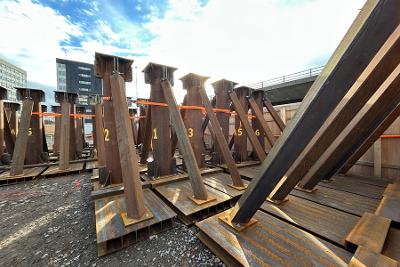
These heavy duty props have been built by specialist contractors to support the weight of the Gateshead Highway flyover during demolition work.
Before work can begin on demolishing the flyover, lots of preparation has been necessary, including getting these props in place.
The 1960s concrete structure was based on an innovative design, using post-tensioning to provide primary support, and unusually wide 'cantilevers' where the two sides of the roadway counter-balance one another, all held up by central pillars known as piers.
Our contractors BAM have commissioned dozens of these heavy duty steel props to support the weight of the concrete while the demolition machines gradually eat away at either side of the structure simultaneously, cutting the steel tendons in the process. The props were manufactured in the UK by specialist contractor Construct-IT.
Depending on the flyover's height above ground level, BAM will use a combination of different size props to support the structure.
The demolition process has been carefully designed with specialist consulting engineers Andun, to see machinery 'nibble' concrete away on either side of the flyover at the same time.
This will ensure the structure's cantilevers remain balanced and stable while demolition continues.
Before demolition begins on the central section of the flyover, our contractors will also put in place two substantial 'screens' using scaffold, boards and sheeting to protect the Aidan House building and its tenants, and the car park at the southern end of the High Street, next to the Matalan store.
The screen for Aidan House will be roughly 50 metres in length, eight metres high and two metres in depth.
Similar structures will also be required for later stages of the demolition, to protect buildings like Peareth Court and Park Court - but these will be designed specifically for those locations.
It's necessary to put these structures in place, due to the structural design of the flyover, with the post-tensioned cables within the concrete, and the potential for debris to break off the structure and cause damage.
Councillor Martin Gannon, Leader of Gateshead Council, said:
"We're now getting close to the main demolition of the flyover starting.
"Huge amounts of detailed work has been done already, to ensure this complex structure is demolished safely, and these props are a vital part of the jigsaw to keep everybody safe, and prevent any unexpected issues arising when the post-tensioned steel and concrete structure is removed.
"We can't wait to see the demolition machines move in and start doing their vital work, and we know the Gateshead public want to see that too."
Jim Smyth, Senior Agent from BAM, said:
"Demolishing a structure like the Gateshead Highway flyover requires a huge amount of planning and preparation before any concrete is removed.
"These heavy-duty steel props play a critical role in safely supporting the structure while demolition takes place and they are an important step towards transforming this vital part of Gateshead town centre."
These heavy duty props have been built by specialist contractors to support the weight of the Gateshead Highway flyover during demolition work.
Before work can begin on demolishing the flyover, lots of preparation has been necessary, including getting these props in place.
The 1960s concrete structure was based on an innovative design, using post-tensioning to provide primary support, and unusually wide 'cantilevers' where the two sides of the roadway counter-balance one another, all held up by central pillars known as piers.
Our contractors BAM have commissioned dozens of these heavy duty steel props to support the weight of the concrete while the demolition machines gradually eat away at either side of the structure simultaneously, cutting the steel tendons in the process. The props were manufactured in the UK by specialist contractor Construct-IT.
Depending on the flyover's height above ground level, BAM will use a combination of different size props to support the structure.
The demolition process has been carefully designed with specialist consulting engineers Andun, to see machinery 'nibble' concrete away on either side of the flyover at the same time.
This will ensure the structure's cantilevers remain balanced and stable while demolition continues.
Before demolition begins on the central section of the flyover, our contractors will also put in place two substantial 'screens' using scaffold, boards and sheeting to protect the Aidan House building and its tenants, and the car park at the southern end of the High Street, next to the Matalan store.
The screen for Aidan House will be roughly 50 metres in length, eight metres high and two metres in depth.
Similar structures will also be required for later stages of the demolition, to protect buildings like Peareth Court and Park Court - but these will be designed specifically for those locations.
It's necessary to put these structures in place, due to the structural design of the flyover, with the post-tensioned cables within the concrete, and the potential for debris to break off the structure and cause damage.
Councillor Martin Gannon, Leader of Gateshead Council, said:
"We're now getting close to the main demolition of the flyover starting.
"Huge amounts of detailed work has been done already, to ensure this complex structure is demolished safely, and these props are a vital part of the jigsaw to keep everybody safe, and prevent any unexpected issues arising when the post-tensioned steel and concrete structure is removed.
"We can't wait to see the demolition machines move in and start doing their vital work, and we know the Gateshead public want to see that too."
Jim Smyth, Senior Agent from BAM, said:
"Demolishing a structure like the Gateshead Highway flyover requires a huge amount of planning and preparation before any concrete is removed.
"These heavy-duty steel props play a critical role in safely supporting the structure while demolition takes place and they are an important step towards transforming this vital part of Gateshead town centre."