
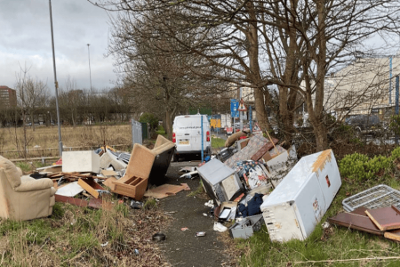
LGA calls for urgent sentencing review as court fines for fly-tipping undercut council penalties
The council is supporting the Local Government Association (LGA) in asking Government and the Sentencing Council to urgently review sentencing guidelines for fly-tipping, after new figures show that offenders prosecuted through the courts are often fined less than the penalties councils can issue directly.
The average court fine for fly-tipping is £539, which is lower than the £626 average fixed penalty notice (FPN) councils can issue for the same offence. The LGA says this sentencing gap undermines deterrence, weakens enforcement, and leaves councils out of pocket after time-consuming and costly prosecutions.
Councillor John McElroy, Cabinet for Environment and Transport, said:
"Environmental crimes are unacceptable and will not be tolerated as they spoil the local environment for everyone. Fly-tipping in Gateshead costs us over £400,000 a year just to remove and dispose of the waste - all money that could be used for other essential services, so it is crucial that the punishment for committing these crimes is severe enough to prevent people doing it.
"In September we increased the level of our FPNs for this reason and earlier this year issued our first £1,000 fine for fly-tipping which has since been paid. Taking enforcement action can be a lengthy process so the outcome needs to reflect the seriousness of the crime."
Following additional investment in environmental services over the last three years Gateshead Council has taken more enforcement action through the environmental anti-social behaviour and enforcement teams but this often requires lengthy investigations, high evidential thresholds and significant staff time.
Earlier this month Martin Taylor of Dunston was found guilty by the courts of unlawfully depositing waste in and around the rear alleyway of Spoor Street and was issued a £120 fine with £566 costs. Alongside this a resident was found guilty of an unlawful deposit of controlled waste on land at Sunderland Road and was fined by the council a total of £461.
The LGA says sentencing guidelines are now out of step with the real impact of fly-tipping on communities, the environment and public finances, and that tougher penalties are needed to deter repeat and organised offenders.
Cllr Arooj Shah, LGA environment spokesperson, said:
"Fly-tipping is criminal activity that blights communities and costs taxpayers millions of pounds every year."Councils are working hard to investigate and prosecute offenders, but when court fines are lower than fixed penalties, it undermines enforcement and fails to act as a deterrent.
"Sentencing guidelines must be reviewed so that the punishment fits the crime and reflects both the harm caused and the significant work undertaken by enforcement officers."
The LGA says stronger sentencing would also support the Government's ambition to improve pride in place by protecting local environments and public spaces.
The council is supporting the Local Government Association (LGA) in asking Government and the Sentencing Council to urgently review sentencing guidelines for fly-tipping, after new figures show that offenders prosecuted through the courts are often fined less than the penalties councils can issue directly.
The average court fine for fly-tipping is £539, which is lower than the £626 average fixed penalty notice (FPN) councils can issue for the same offence. The LGA says this sentencing gap undermines deterrence, weakens enforcement, and leaves councils out of pocket after time-consuming and costly prosecutions.
Councillor John McElroy, Cabinet for Environment and Transport, said:
"Environmental crimes are unacceptable and will not be tolerated as they spoil the local environment for everyone. Fly-tipping in Gateshead costs us over £400,000 a year just to remove and dispose of the waste - all money that could be used for other essential services, so it is crucial that the punishment for committing these crimes is severe enough to prevent people doing it.
"In September we increased the level of our FPNs for this reason and earlier this year issued our first £1,000 fine for fly-tipping which has since been paid. Taking enforcement action can be a lengthy process so the outcome needs to reflect the seriousness of the crime."
Following additional investment in environmental services over the last three years Gateshead Council has taken more enforcement action through the environmental anti-social behaviour and enforcement teams but this often requires lengthy investigations, high evidential thresholds and significant staff time.
Earlier this month Martin Taylor of Dunston was found guilty by the courts of unlawfully depositing waste in and around the rear alleyway of Spoor Street and was issued a £120 fine with £566 costs. Alongside this a resident was found guilty of an unlawful deposit of controlled waste on land at Sunderland Road and was fined by the council a total of £461.
The LGA says sentencing guidelines are now out of step with the real impact of fly-tipping on communities, the environment and public finances, and that tougher penalties are needed to deter repeat and organised offenders.
Cllr Arooj Shah, LGA environment spokesperson, said:
"Fly-tipping is criminal activity that blights communities and costs taxpayers millions of pounds every year."Councils are working hard to investigate and prosecute offenders, but when court fines are lower than fixed penalties, it undermines enforcement and fails to act as a deterrent.
"Sentencing guidelines must be reviewed so that the punishment fits the crime and reflects both the harm caused and the significant work undertaken by enforcement officers."
The LGA says stronger sentencing would also support the Government's ambition to improve pride in place by protecting local environments and public spaces.