
Demolition of flyover opens up opportunity in Gateshead
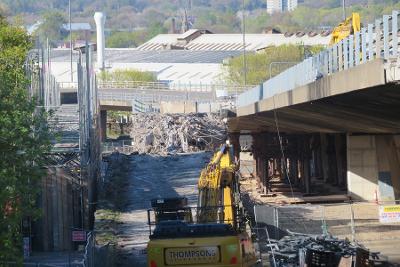
The main demolition work on the Gateshead Highway flyover has begun.
We expect the demolition of the flyover to take around six months, to be complete around October this year.
A total of 40 pairs of props have been placed under the flyover structure, in preparation for demolition beginning.
The first sections of the flyover to be demolished are the 'on' and 'off' ramps in the centre of the structure, just to the south of the Sunderland Road bus lane.
Contractors BAM have started work on these ramps as the structure needs to be demolished in the reverse order to how it was built, and to create access to the main structure.
Once the ramps are down, the team move on to Span 15 of the flyover by the bus lane - which will see a significant gap opened up in the centre of the structure.
Once this section is removed, the next two spans north of the bus lane will be demolished, then the team will move steadily southwards towards Five Bridges roundabout."
We expect the spans over Five Bridges roundabout to see work beginning around late June.
The area around Park Lane roundabout is expected to see demolition works in late summer.
We will then finish the programme with the section of flyover above the Metro tunnels in the autumn.
Anneliese Hutchinson, strategic director for economy, innovation and growth at Gateshead Council, said:
"It's great to see the start of work on demolishing the flyover. Ever since it closed in December 2024, the flyover has been a problem to be solved - and now we are well on the way to solving it.
"Our contractors BAM have rightly prioritised safety and a carefully planned demolition programme - and now we are seeing that careful preparation work come to fruition.
"BAM and their specialist subcontractors Thompsons are on site six days a week and we will see the concrete of the flyover start to be removed - and open up amazing opportunities for regeneration."
The flyover is a very distinctive structure, with the weight carried on central piers, and the road deck built using post tensioned concrete and steel tendons which now need to be severed.
Mechanical excavators will 'nibble' both sides of the flyover at once, to maintain the structure's balance. Props and large concrete blocks are required to restrain the structure during the demolition process.
Jim Smyth, Senior Agent at BAM, said:
"It's a huge undertaking. The flyover is nearly a kilometre long. If it was built today, the designers and contractors would be required by law to leave detailed instructions on how you would maintain it, and ultimately take the flyover down.
"But it was built in the 60s, so none of those regulations existed. We've had to start from scratch, going back to archive drawings, to understand the load paths through the bridge, how it behaves, and how it will behave as we take it down span by span.
"We've gone with the option of mechanical demolition. This involves heavy duty, specialist equipment fitted with hydraulic jaws which munch away at the concrete, pulverise the concrete, and we will do that span by span, keeping an even balance on the structure."
Anneliese added that regeneration plans can now be progressed more rapidly, once the flyover has been removed:
"Recently we've seen announcements about Baltic Quarter, the Old Town Hall, and the Railway Quarter all benefiting from investment and developers committing to Gateshead.
"This is yet another sign of how investment in Gateshead is fundamentally driving change, creating a town centre, and a whole borough, that are fit for the future."
Diversion routes and traffic management plans will soon be finalised and published to local stakeholders, to ensure we minimise disruption while the demolition is ongoing.
We are working with bus operators so they can plan their routes while work is ongoing.
We are working closely together with BAM to minimise disruption to the travelling public, and the demolition partners do not expect the Metro lines will need to close.
However, monitoring equipment has been installed in the tunnels, so if any movement beyond normal levels is detected, the council and Nexus will be alerted immediately to take action.
We have planned and implemented pedestrian diversions around the flyover demolition site.
A map has been produced to show people how to divert via the Five Bridges footbridges to the south, or via the former Lindisfarne Drive road to the east of the flyover, before crossing into the town centre via the Park Lane roundabout or the subway north of the roundabout.
'Haul roads' have also been created either side of the flyover, to provide safe working platforms for the demolition contractors to use, and to remove material from the site.
Waste materials will be taken out mainly via Park Lane roundabout and the Felling bypass and taken to Thompsons' facility at Springwell for recycling, or to be used on construction sites locally.
Buildings alongside the flyover are being protected using scaffolding 'screens' with heavy blocks to anchor them.
BAM also have an extensive social sustainability programme, working with local schools and helping to fund local projects around the flyover and Gateshead town centre. More details of this work will be announced in the coming months.
The main demolition work on the Gateshead Highway flyover has begun.
We expect the demolition of the flyover to take around six months, to be complete around October this year.
A total of 40 pairs of props have been placed under the flyover structure, in preparation for demolition beginning.
The first sections of the flyover to be demolished are the 'on' and 'off' ramps in the centre of the structure, just to the south of the Sunderland Road bus lane.
Contractors BAM have started work on these ramps as the structure needs to be demolished in the reverse order to how it was built, and to create access to the main structure.
Once the ramps are down, the team move on to Span 15 of the flyover by the bus lane - which will see a significant gap opened up in the centre of the structure.
Once this section is removed, the next two spans north of the bus lane will be demolished, then the team will move steadily southwards towards Five Bridges roundabout."
We expect the spans over Five Bridges roundabout to see work beginning around late June.
The area around Park Lane roundabout is expected to see demolition works in late summer.
We will then finish the programme with the section of flyover above the Metro tunnels in the autumn.
Anneliese Hutchinson, strategic director for economy, innovation and growth at Gateshead Council, said:
"It's great to see the start of work on demolishing the flyover. Ever since it closed in December 2024, the flyover has been a problem to be solved - and now we are well on the way to solving it.
"Our contractors BAM have rightly prioritised safety and a carefully planned demolition programme - and now we are seeing that careful preparation work come to fruition.
"BAM and their specialist subcontractors Thompsons are on site six days a week and we will see the concrete of the flyover start to be removed - and open up amazing opportunities for regeneration."
The flyover is a very distinctive structure, with the weight carried on central piers, and the road deck built using post tensioned concrete and steel tendons which now need to be severed.
Mechanical excavators will 'nibble' both sides of the flyover at once, to maintain the structure's balance. Props and large concrete blocks are required to restrain the structure during the demolition process.
Jim Smyth, Senior Agent at BAM, said:
"It's a huge undertaking. The flyover is nearly a kilometre long. If it was built today, the designers and contractors would be required by law to leave detailed instructions on how you would maintain it, and ultimately take the flyover down.
"But it was built in the 60s, so none of those regulations existed. We've had to start from scratch, going back to archive drawings, to understand the load paths through the bridge, how it behaves, and how it will behave as we take it down span by span.
"We've gone with the option of mechanical demolition. This involves heavy duty, specialist equipment fitted with hydraulic jaws which munch away at the concrete, pulverise the concrete, and we will do that span by span, keeping an even balance on the structure."
Anneliese added that regeneration plans can now be progressed more rapidly, once the flyover has been removed:
"Recently we've seen announcements about Baltic Quarter, the Old Town Hall, and the Railway Quarter all benefiting from investment and developers committing to Gateshead.
"This is yet another sign of how investment in Gateshead is fundamentally driving change, creating a town centre, and a whole borough, that are fit for the future."
Diversion routes and traffic management plans will soon be finalised and published to local stakeholders, to ensure we minimise disruption while the demolition is ongoing.
We are working with bus operators so they can plan their routes while work is ongoing.
We are working closely together with BAM to minimise disruption to the travelling public, and the demolition partners do not expect the Metro lines will need to close.
However, monitoring equipment has been installed in the tunnels, so if any movement beyond normal levels is detected, the council and Nexus will be alerted immediately to take action.
We have planned and implemented pedestrian diversions around the flyover demolition site.
A map has been produced to show people how to divert via the Five Bridges footbridges to the south, or via the former Lindisfarne Drive road to the east of the flyover, before crossing into the town centre via the Park Lane roundabout or the subway north of the roundabout.
'Haul roads' have also been created either side of the flyover, to provide safe working platforms for the demolition contractors to use, and to remove material from the site.
Waste materials will be taken out mainly via Park Lane roundabout and the Felling bypass and taken to Thompsons' facility at Springwell for recycling, or to be used on construction sites locally.
Buildings alongside the flyover are being protected using scaffolding 'screens' with heavy blocks to anchor them.
BAM also have an extensive social sustainability programme, working with local schools and helping to fund local projects around the flyover and Gateshead town centre. More details of this work will be announced in the coming months.