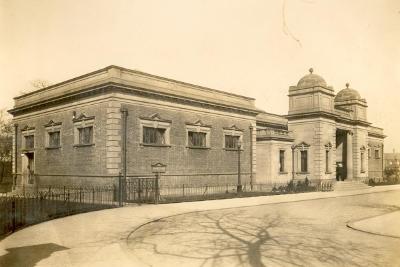
As Gateshead Library turns 100, we're looking back at some of the key milestones in its history, from 1925 to today. Come take a look through our archive with us.
Early 1900s
The idea for a new Central Library started in the early 1900s.
Though Gateshead already had a library on Swinburne Street, it was becoming clear it was too small for the number of residents wanting to borrow books. So, the Library Committee started looking for opportunities to build a new, bigger library.
To help fund this exciting venture, the committee applied for a grant from The Carnegie Trust, a charity funding new libraries, schools, hospitals and other public buildings. The Carnegie Trust agreed that 'the stock of books is in no wise commensurate with the population of the town' and agreed to support the project.
And thus, the search for a new Gateshead Central Library could begin in earnest.
1926
After years in the making, Gateshead Central Library was officially opened on 31 March 1926 by the Earl of Elgin. The state-of-the-art building was met with great fanfare.
The services the landmark venue offered were pioneering. For the first time, customers could browse and select books for themselves rather than having to look up and request items from a librarian. In addition, students could request educational or vocational books on any subject,there were books for blind people, children's books and a collection of local history items.
Unsurprisingly, the library proved a roaring success. In its first year alone, 12,065 people became members - almost 10% of Gateshead's population at the time. Plus, on a particularly busy day, staff issued over 3,500 books to customers.
1928
Just two years after the library opened it was growing more and more popular. Borrowing was up from 130,072 to 637,091 books a year, and there could be as many as 200 people found amongst the shelves at any one time. In the early days, you might even have to queue to get in.
This surge in readership was partly driven by the increasing number of fiction books coming to print at the time. The public had a big appetite for this genre.
To manage the growing demand, we introduced book reservations. The price to get your hands on a 'bespoken book'? A single penny.
1939 to 1945
Before World War II, customers used to set out on foot from all over the borough to get to Central Library. However, as fighting broke out it was important that longer walks were avoided wherever possible to keep the public safe.
As a result, we opened delivery stations across Lobley Hill, Sherrif Hill, Old Fold, Low Fell and Saltwell. These were places where customers could choose from a small selection of books or order others to be sent from the Central Library.
You could say this laid the groundwork for our Readers at Home service, which came to fruition years later in 1960.
1948
Enter our first dedicated children's library.
Children's books had been growing in popularity for a number of years, and by 1948 we needed to create our very first children's section. This collection was looked after by Eva Johnson, our inaugural children's librarian.
1965
In a big moment for Gateshead, in August 1965 Gateshead Central Library introduced a Gramophone Lending Library. This was a proud moment as it was the first in North East.
By 1970, 16,024 records had been borrowed and over the coming years the service developed to include the loan of cassette tapes, CDs and DVDs.
1975
1975 saw the introduction of our mobile library service - also known as the 'travelling library'. When many areas of former County Durham became a part of Gateshead after a local government reorganisation the same year, this was a much-needed evolution. Highlighting just how popular it was, it issued 1,786 books in just the first month.
Expanding our services further, this was also the year that a major extension to Central Library was underway. This included the addition of Caedmon Hall, which was billed as one of the most progressive cultural centres in the area at the time. It finally opened to the public in 1976 after two years under construction.
1984
In a world-first, in 1984 72-year-old resident Jane Snowball did a digital shop using the Central Library's Videotex service. Through Videotex, Jane used her TV remote to order groceries from her local Tesco. On her shopping list were margarine, cornflakes and eggs. This was years before the world wide web and online shopping boomed into a billion-pound industry.
2000
Introduction of the Government funded 'People's Network' nationally led to the introduction of the internet to all libraries. At the Central Library, this was a vast improvement to the dial up connection that had been in place previously and was the biggest shift in technology, with the introduction of over 20 public computers at the Central Library.
2010s
In 2010, Central Library underwent its biggest refurbishment and extension to date to finally provide a dedicated children's library and teenage space. We also grew the building to include space for a cafe and art gallery. We also re-opened access to the library through the original historic entrance, which had been out of use for many years.
Then in 2013, we made eBooks available to residents for the first time. This has completely transformed our offering to customers, making it even more convenient to borrow their favourite titles.
Hot on the heels of the 2010 expansion and thanks to Lottery funding, we opened Gateshead Archive in 2019 to showcase Gateshead Local Studies Collection. Over 8,000 local history books which had previously been closed access, were made available to the public. There was also an installation of interactive screens to showcase our collections.
In 2020, we opened the MakerPlace - a space for digital-based craft and design like 3D printing and laser cutting. Launched, shortly before the first lockdown of the Covid pandemic, the team spent the first months producing 7,500 visors for local care homes.
2026
Gateshead Central Library celebrates its 100 birthday!
Since its early days as a place mainly to borrow books, Central Library is now home to a historic archive, lending library, young people's libraries, technology space, public computers, a cafe, art gallery, performance hall, community rooms, banking facilities and much more.
We now have 14,085 members at Central Library alone and this year we've issued 168,975 items from print books to CDs and ebooks. Thousands more have attended our events, from craft sessions, computer lessons and storytimes to history walks and art exhibitions.
We can't wait to see what the next 100 years brings!